
Exploring the Inequalities and Diversities in Disabled Young Adult Transitions
Disabled young people experience lots of things as they move towards adulthood. Changes can be in areas such as education, employment, housing, leisure, relationships and family, service changes from health or social care. The types of issues disabled young people experience will not be the same – they will be different for all kinds of reasons. The types of adulthood that disabled young people want will also vary.
We are a group of researchers who have undertaken research examining these issues. Below are our Key Findings and the Policy Recommendations we are making from them. You can also read our Policy Briefs and provide Feedback on the project.
The different pages provide more information about the project and you can Contact Us if you have any questions.
Scottish Project Lead: Charlotte Pearson (charlotte.pearson@glasgow.ac.uk)
North East England Project Lead: Janice McLaughlin (janice.mclaughlin@newcastle.ac.uk)
Key Findings and Policy Recommendations
Experiences Seeking Employment
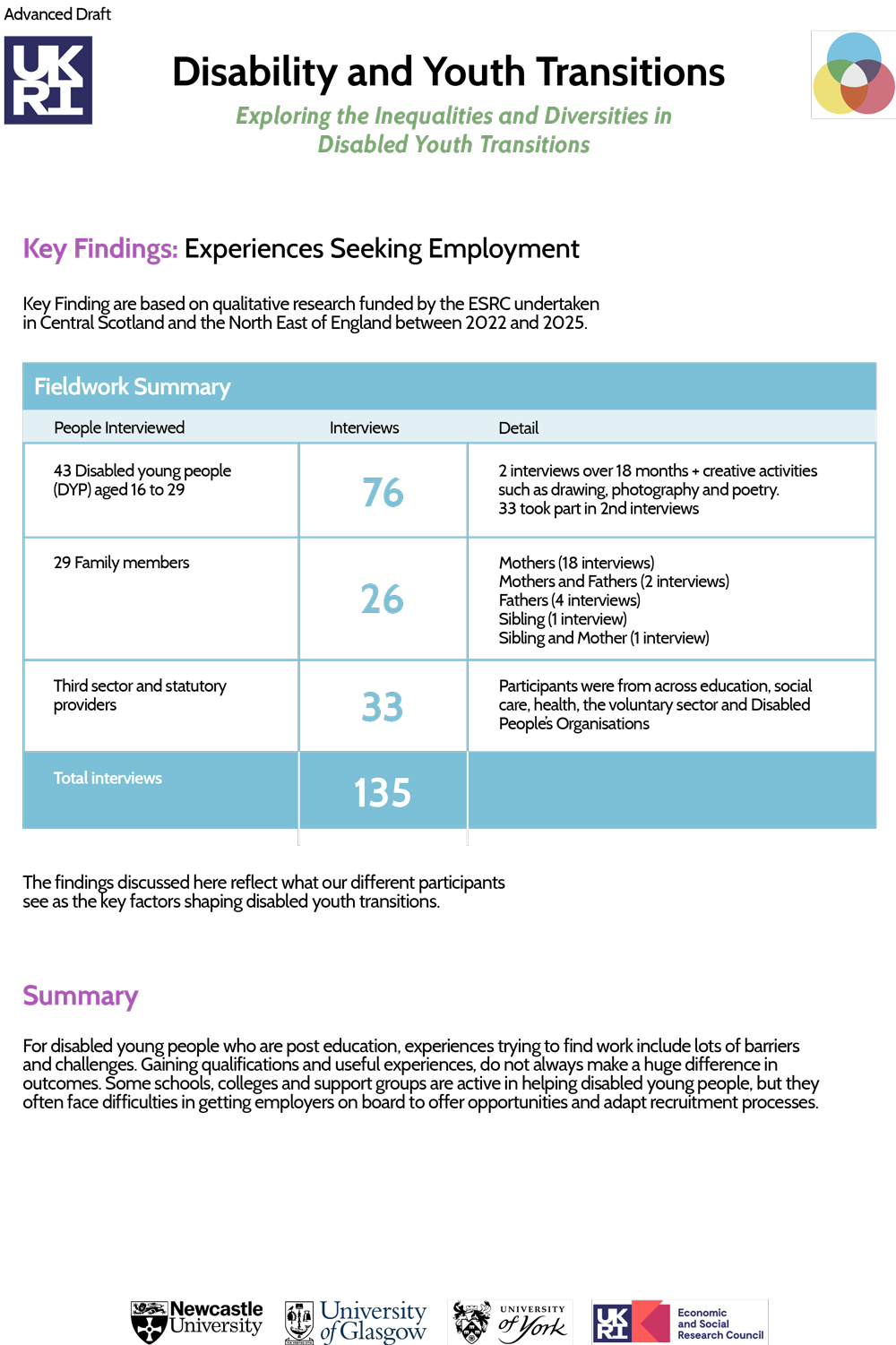
For disabled young people who are post education, experiences trying to find work include lots of barriers and challenges. Gaining qualifications and useful experiences, do not always make a huge difference in outcomes. Some schools, colleges and support groups are active in helping disabled young people, but they often face difficulties in getting employers on board to offer opportunities and adapt recruitment processes…
Families and Interdependencies

Families are central to disabled young people’s lives, and are often experienced as supportive, dependable and loving. Most disabled young people spoke about the vital role that family, usually mums, played in advocating for them throughout their lives. For some, however, family is a source of pain and sometimes abuse. Where disabled young people are estranged from families, some have found family in other settings – through a partner’s family or in a foster family. Support organisations play a key role in the lives of many disabled young people, and can be experienced as a kind of family…
Education and Social Participation

Having opportunities to have a social life are an important part of ensuring the health and wellbeing of disabled young people. There are numerous barriers to disabled young people being able to participate in social life. The costs are high. Support groups are filling in much of the gap, but they need need better and more secure funding to play that role. Other institutions, particularly schools, need to do a better job of enabling disabled young people to be welcomed…
Social Care
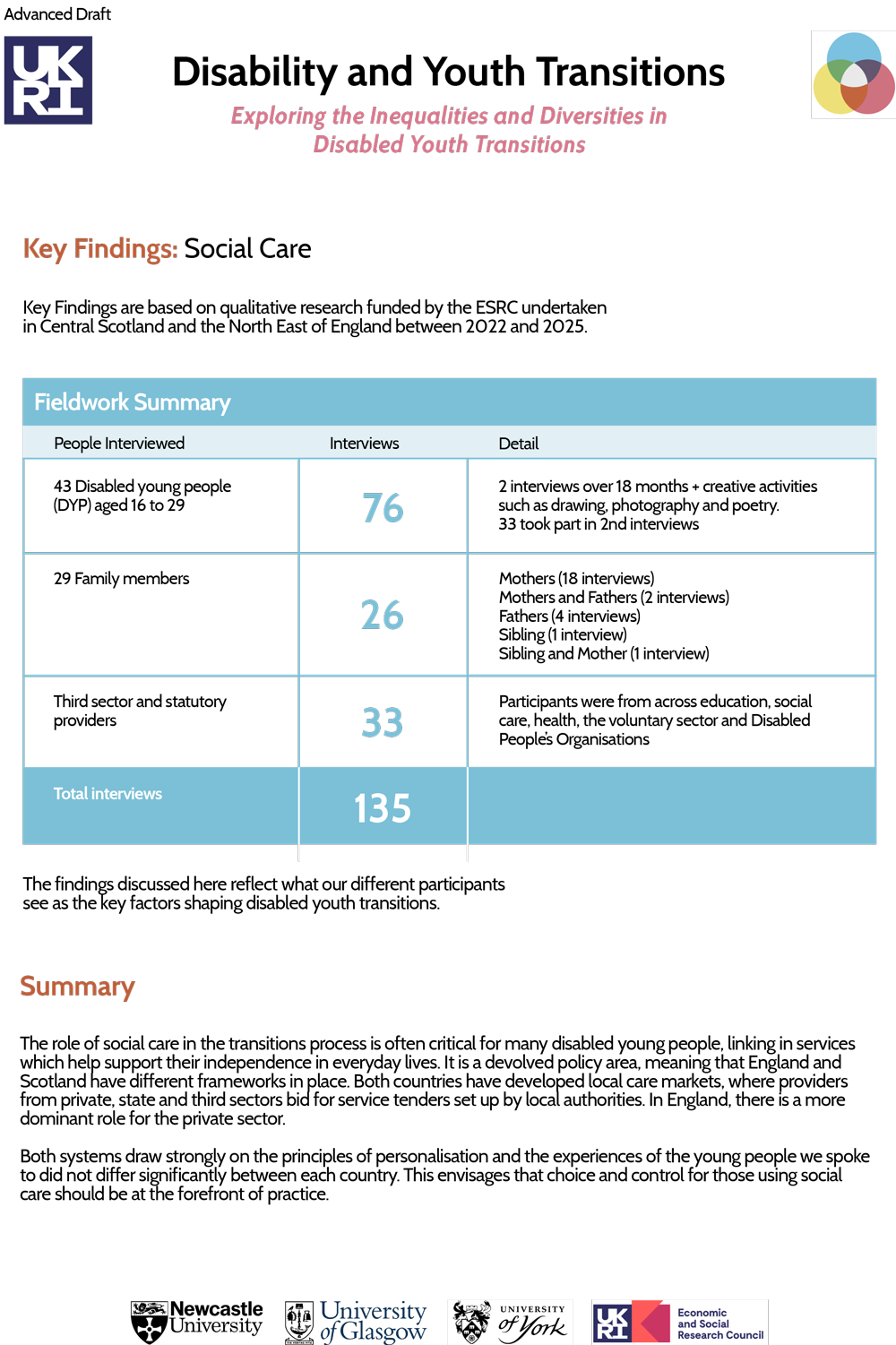
The role of social care in the transitions process is often critical for many disabled young people, linking in services which help support their independence in everyday lives. It is a devolved policy area, meaning that England and Scotland have different frameworks in place. Both countries have developed local care markets, where providers from private, state and third sectors bid for service tenders set up by local authorities. In England, there is a more dominant role for the private sector…
Policy Briefs
Over the course of the project we produced a series of policy briefs for decision-makers and stakeholders in the North East of England and Scotland based on the findings of our research.
August 2025
Policy Brief 5:
Education, Health and Social Care Plans in the North East

Policy Brief 5 looks at what has been framed in the media as the SEND crisis in Schools in England and the suggestion that one solution is to remove Education, Health and Social Care Plans. We argue against that idea.
Policy Brief 5 (Easy Read)

Here is an Easy Read version of Policy Brief 5: Education, Health and Social Care Plans in the North East.
January 2025
Policy Brief 4:
Good Practice in Helping Disabled Young People Find Work in the North East

Policy Brief 4 focuses on the North East and the challenges disabled young people can experience gaining employment and the difference colleges, placement providers and employers can make in resolving some of those challenges.
Policy Brief 4 (Easy Read)

Here is an Easy Read version of Policy Brief 4: Good Practice in Helping Disabled Young Find Work in the North East.
January 2025
Policy Brief 3:
Good Practice in Supporting Disabled Young People in Scotland
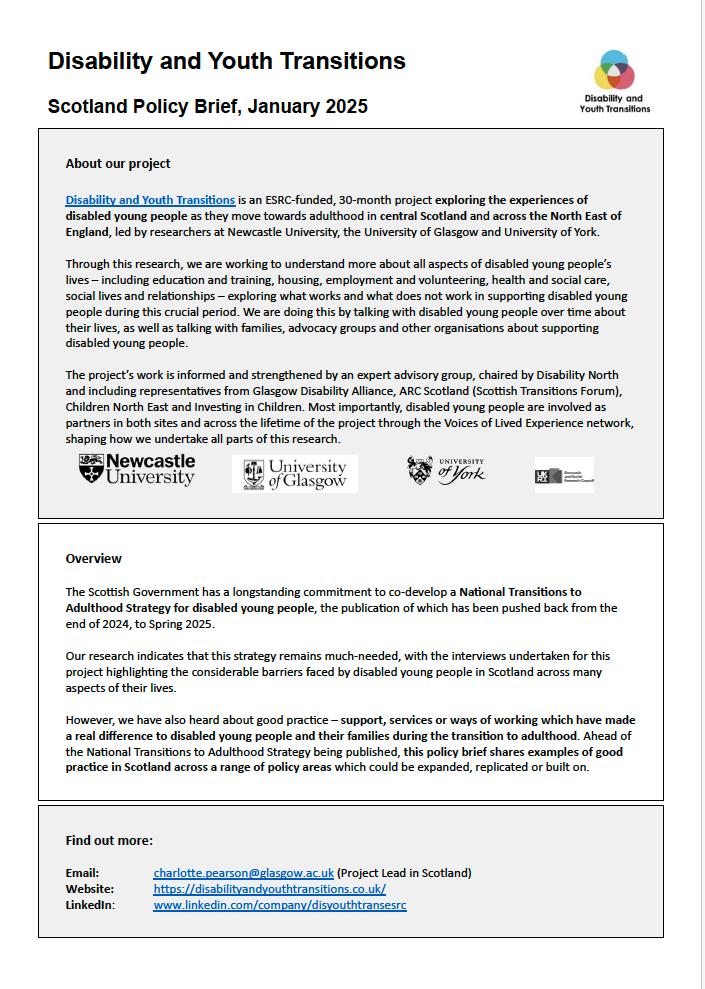
Policy Brief 3 details a series of positive areas of provision and practice in Central Scotland that are making a difference in the transition experiences of disabled young people.
Policy Brief 3 (Easy Read)

Here is an Easy Read version of Policy Brief 3: Good Practice in Supporting Disabled Young People in Scotland.
October 2024
Policy Brief 2:
Holistic Approaches to Transition Planning in the North East
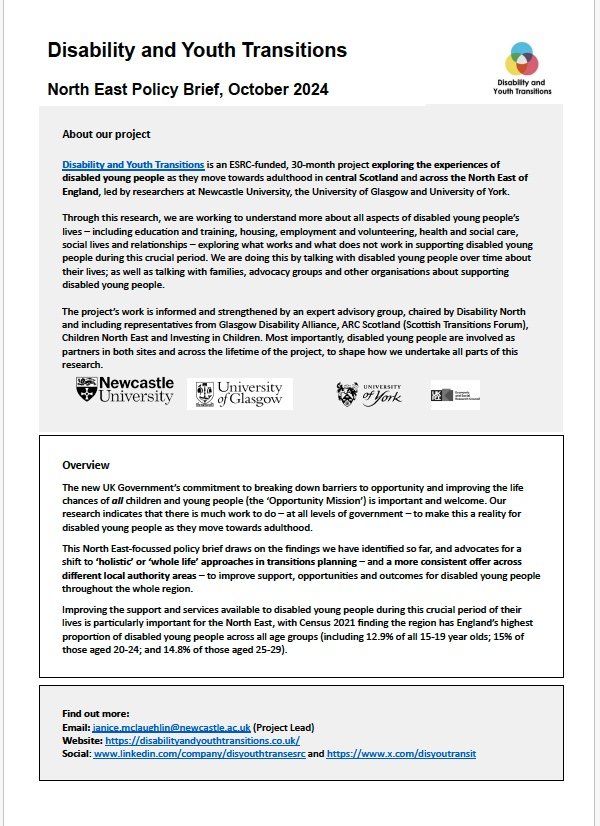
Policy Brief 2 focused on the North East explores what a holistic approach to supporting disabled youth transitions would look like and the current barriers to it occurring. It proposes the change in UK government and the expanded role of the Combined Authorities of both the North East and Tees Valley provide an opportunity to take this different approach.
Policy Brief 2 (Easy Read)
Here is an Easy Read version of Policy Brief 2: Holistic Approaches to Transition Planning in the North East.
April 2024
Policy Brief 1:
Transitions and the UK Government Disability Action Plan
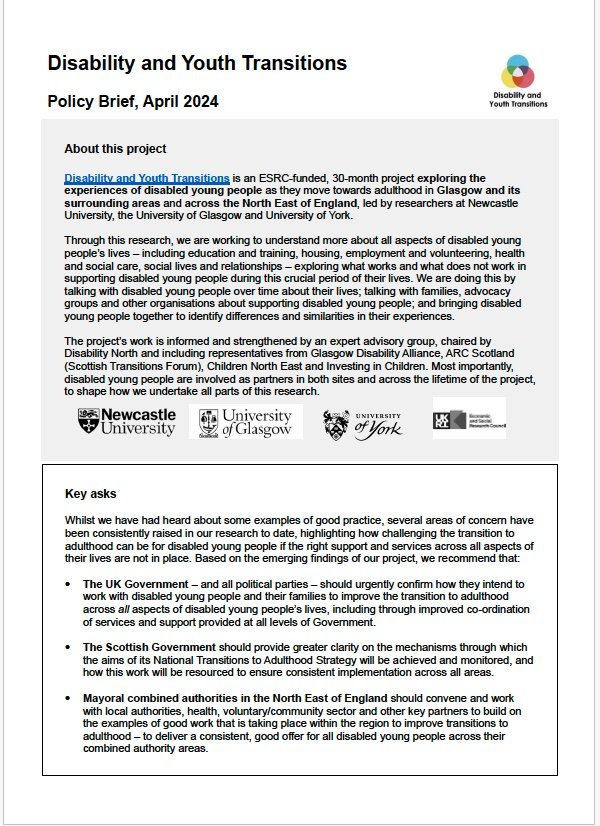
Our first Policy Brief, with a focus on the UK Government’s Disability Action Plan; the Scottish Government’s National Transitions to Adulthood Strategy; and a recommendation for the North East’s two mayoral combined authorities and local partners.
Feedback
We would love to hear what you think about our research. If you have any feedback, you can send it to us using the form below…